

Consent in documentary work must be an ongoing, power-aware process, not a one-time signature.
A signed release is not enough when one side controls the camera, the edit, the money, and the audience. If I want consent to mean anything in documentary work, I have to match it to power, risk, and how the project may change over time.
Here’s the short version:
Written consent gives me a paper trail, but it can still fail if the form is rushed or hard to follow.
Verbal consent can work in the field, but it is weak if I don’t record it or if the person does not feel free to say no.
Group consent may fit shared community decisions, but it can hide disagreement from individuals.
Repeat consent matters when the story, edit, release plan, or use of footage changes.
If the project involves minors, trauma, medical settings, money, streaming release, or AI reuse, one step is not enough. I should use plain-language explanation + on-camera verbal agreement + written release, then check in again before any new use.
A few points stand out from the article:
The filmmaker usually controls 4 big things: camera, schedule, edit, and release.
Risk can grow after filming, especially when footage moves to festivals, social platforms, streaming, or archives.
For sensitive material, the article suggests a 7-day review window after the edit is locked.
A consent file should include dated notes, signed forms, recorded verbal consent, and current contact details.
The Ethical Lines in Documentary Filmmaking
Quick Comparison
Consent type | What it does well | Where it can fail | Best use |
|---|---|---|---|
Written | Shows permission in a formal record | People may sign without grasping the terms | High-risk shoots and paid distribution |
Verbal | Works in fast field settings | Hard to prove later if not recorded | Short check-ins and public situations |
Group | Fits shared decision-making | One person’s no can get lost | Community-based projects |
Repeat | Lets consent track new risks | Useless if nothing new is explained | Long shoots and changing release plans |
My takeaway: consent is not a one-time form. It is a process. If power is uneven, I need to slow down, explain the project in plain words, give people time, use translation when needed, and ask again when the risk changes.
How Each Consent Method Works and Where It Fails
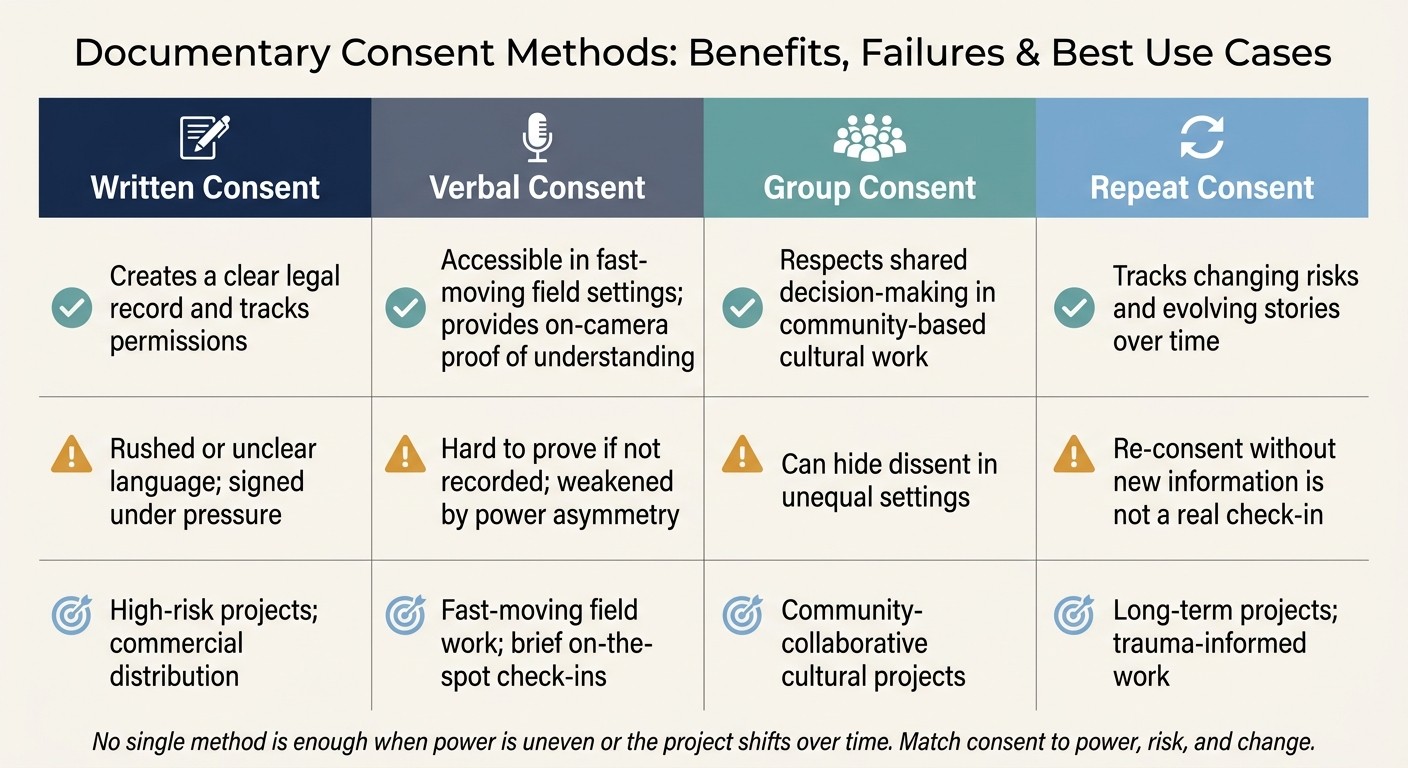
Documentary Consent Methods: Benefits, Failures & Best Use Cases
Written and Verbal Consent
In unequal settings, the hard part isn't getting a yes. It's figuring out whether that yes can hold up under pressure, confusion, and changing circumstances.
Written consent creates a legal record. That matters. But a signed form doesn't automatically mean the person understood what they were agreeing to. If the form is rushed, packed with legal language, or handed to someone who feels they can't refuse, the signature can turn into a box-checking exercise instead of real agreement.
A form can reduce legal risk without reducing harm.
Verbal consent can work well in fast-moving field settings where stopping for paperwork would break the flow. And if it's recorded on camera, it can show understanding in a way a written signature sometimes can't. The weak spot is proof. If verbal consent isn't recorded or logged with the date and context, it's hard to verify later, especially when a large production team is involved. Verbal consent also breaks down when the subject cannot safely say no.
When consent moves from one person to a group, or when it needs to be checked again over time, the risks shift too.
Group and Repeat Consent
Group consent rests on the idea that some communities make decisions together. In community-based cultural work, that can make sense because it respects shared decision-making. But there's a catch: group agreement can also bury disagreement, especially in unequal settings.
Repeat consent means checking in again as the project changes. It works best when producers are clear about what's different and what that change means. If there's no new information, re-consent isn't much of a check-in at all.
Consent Method | Main Benefit | Common Failure Point | Best Fit |
|---|---|---|---|
Written | Creates a clear legal record and tracks permissions | Rushed or unclear language; signed under pressure | High-risk projects; commercial distribution |
Verbal | Accessible in fast-moving field settings; provides on-camera proof of understanding | Hard to prove if not recorded; weakened by power asymmetry | Fast-moving field work; brief on-the-spot check-ins |
Group | Respects shared decision-making in community-based cultural work | Can hide dissent in unequal settings | Community-collaborative cultural projects |
Repeat | Tracks changing risks and evolving stories over time | Re-consent without new information is not a real check-in | Long-term projects; trauma-informed work |
The next step is matching the method to the level of risk.
Matching the Consent Method to the Level of Risk
Low-Risk, High-Risk, and Changing-Risk Scenarios
When filmmakers control access, editing, and release, the consent method needs to fit both the level of risk and the power gap. Not every project carries the same chance of harm, so it helps to sort situations into three groups:
Risk Level | Scenario Examples | Recommended Consent Method |
|---|---|---|
Low-Risk | Public events, non-identifiable b-roll, general street observation | Verbal consent or a simple short written release |
High-Risk | Minors, trauma survivors, medical settings, sensitive personal attributes | Written release + recorded verbal consent + guardian signature |
Changing-Risk | Projects moving to broad distribution, monetization, or AI repurposing | Fresh consent for new uses; clear permission for AI and derivative uses |
Group consent may work for community-level decisions, but it does not replace individual consent when exposure is personal or the stakes are high.
Distribution can grow over time, and consent has to grow with it. A film that starts small can end up on streaming platforms, in paid campaigns, or inside AI-based reuse. That changes the risk. If one consent method leaves holes, layered consent is the safer path than betting everything on one step.
When Layered Consent Is the Better Answer
One consent method often isn't enough when the filmmaker holds far more power than the subject. In those cases, use this three-step process on site: explain the project in plain language, record the participant's verbal agreement on camera, then obtain a signed written release.
Each step does a different job:
The plain-language explanation helps the person understand what they're saying yes to.
The recorded verbal statement shows that the choice was voluntary.
The written release creates the legal record.
For high-risk projects, a staged release model adds one more safeguard: a short-term release for festival screenings, then a separate extended release before wide digital distribution. That gives subjects a real chance to pause and reconsider before their story reaches a much bigger audience.
Layered consent helps close the gaps a single method can leave open, especially when the person agreeing has less power than the person behind the camera.
Still, even layered consent can fall apart without plain language, translation, time, and solid recordkeeping.
Practical Safeguards That Make Consent More Reliable
Plain Language, Translation, and Time to Decide
These safeguards make layered consent something people can actually use.
Before any camera rolls, explain how the footage will be used, where it will appear, whether it will be monetized, and whether it may be reused by algorithms or AI. Use plain language. Name the exact platforms. Skip vague legal wording like "broad uses". This matters even more when the filmmaker controls access, timing, and release.
Once the terms are clear, translation and interpretation turn that clarity into something real. If participants speak a different language, informed consent requires translated written materials and a professional interpreter.
Timing matters too. Don’t ask for a signature right before filming or right after an emotional interview. Give participants a cooling-off period of a few days. For sensitive segments, use a seven-day review period after the edit is locked.
Documentation, Check-Ins, and Post-Production Review
Clear consent only works if you document it.
A consent master file for each participant should include:
Dated production notes
Signed releases
Recorded verbal consent
Current contact information for future permissions
That file matters when someone later asks for proof of ethical standards. It also matters when changes to the edit, audience, or use mean you need to revisit what was first agreed to.
Consent should be revisited when the edit changes, distribution expands, or footage is reused by AI. When you return to consent as the project shifts, it stays tied to the person, not just the paperwork.
As social impact storytelling strategist Matt Mahmood-Ogston puts it:
"Legal permission is necessary, but it is not sufficient. You need both the form and the question. The signature and the gut check."
Conclusion: Consent Is a Process, Not a One-Time Signature
Across the methods above, the rule is simple: match consent to power, risk, and change. Power affects whether consent is free, informed, and lasting.
Written releases offer legal cover. Verbal consent can show understanding in the moment. Group consent can help with shared decision-making. Repeat consent keeps pace with changing risk. No single method is enough when power is uneven or the project shifts over time.
That logic only holds when the process is clear, translated, and revisited. Lasting consent depends on plain language, translation, time to decide, documented check-ins, and a review window for sensitive material - because risk can change as footage moves.
The goal is not a signature. It is consent that stays valid as the story, audience, and risk change.


Let’s keep in touch.
Discover more about high-performance web design. Follow us on Twitter and Instagram.

