

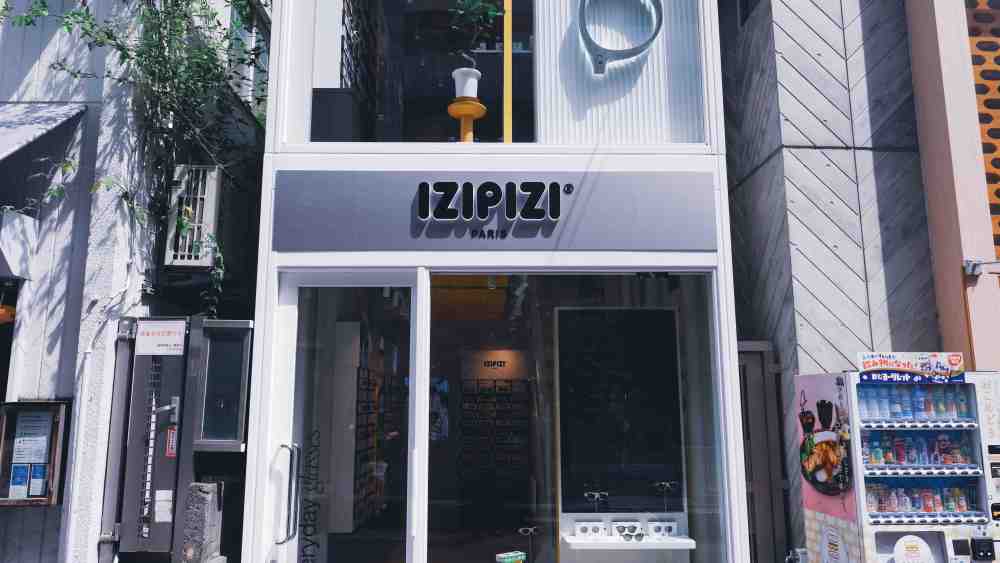
Izipizi has opened its first stand-alone store in Tokyo, giving the French ready-to-wear eyewear brand its first retail location in Asia and a new base for broader expansion across the region.
The store, on Cat Street in the area between Shibuya and Harajuku, opened last July. It marks a shift for a company that had spent the past decade selling in Japan through local wholesale partner Ideaport and through retailers including Beamsand Isetan.
"We have always been willing to develop worldwide for Izipizi - meaning not only focused on Europe or France but selling our products all over the world", said cofounder Charles Brun.
Brun said the opening also carries personal significance. The former investment banker studied Japanese in junior high and said he has long been drawn to the country. "I fell in love with Japan pretty young, and it was my personal dream to open a store there", Brun said. "But also Tokyo is such an important city in the worldwide fashion aspect, alongside London, Paris, New York."
The company is using the Tokyo location to see how its retail model performs in Asia. Brun said the customer base so far has been split evenly between Japanese shoppers and tourists from Europe, the U.S. and Australia.
That mix matters to Izipizi as it pushes further beyond traditional eyewear positioning. The brand sells nonprescription "ready-to-wear" glasses priced up to around 90 euros and has increasingly framed itself as a fashion accessories label. "We are a fashion brand in the optic industry", Brun said.

A brand built around simplicity
Founded in 2010 as See Concept, the company changed its name to Izipizi in January 2017 after deciding the earlier branding was not memorable enough.
"What we noticed with See Concept is that nobody could remember it", Brun said. "We wanted a different name that people could remember, and which was more, I would say, a philosophy of life."
That philosophy, he said, centers on accessibility and ease. "We want to make sure everything is easy", Brun said. "It explains who we are and how we work. We are not snobs. We are not posh. And, in one sense, we are a bit anti-fashion because we want to be simple and easy to work with for our team, our partners and our customers."
He added: "It’s an expression we know from childhood - easy, peasy, lemon squeezy", he said.
Rather than compete directly with opticians, Izipizi has positioned its glasses as fashion accessories sold through fashion and design stores, museums, resorts, sports stores, children’s stores and independent opticians. In the U.S., New York’s MoMa was one of its first customers. The brand is now sold in places including Bloomingdale’s and Barnes & Noble’s most upscale locations, such as the Hamptons.
Its relationship with optical retailers has changed over time, according to Brun. He said opticians were initially skeptical of the lower-priced ready-to-wear product, but collaborations and growing recognition of the brand’s fashion appeal helped drive demand. Today, the company limits its distribution in France. "We only work with independent high-end optic stores", Brun said.
Japan as a platform for Asia
The Tokyo store is also helping the company tailor products to local demand. Brun said Izipizi has developed lighter-tinted sunglasses for Japan because darker lenses carry a cultural association there. The company has also introduced Japan-specific colors and transparent frames, and worked with Japanese fashion label Engineered Garments. Brun said that partnership was a fast success. "That collaboration, Brun said, sold out in Japan within two days."
From Japan, Izipizi is looking to deepen its presence across Asia. The company already works with partners in South Korea, Singapore, Taiwan and Indonesia, where it has tested pop-ups or kiosks. It is in discussions with its Korean partner about opening a mono-brand store in Seoul sometime next year, likely in a high-end mall. It is also talking with potential partners in the Philippines, Thailand and Vietnam and weighing retail rollouts in those countries between 2027 and 2028.
"It’s really a trendy region, and it’s a growing region", Brun said. "There are more tourists going to Asia from all over the world and, of course, the local population is also growing. So I think tomorrow the spending power will be in these countries, with all the trendiness coming from South Korea and Japan.
"So, if you’re able to be strong in Japan and [South] Korea, it helps you for Asia, but it also helps you for the rest of the world", he said.
China could also return to the company’s plans. Izipizi previously operated there with a partner it later dropped, and Brun said a new wholesale partner could come around 2028. Reflecting on the earlier effort, he said: "I think you really have to adapt your brand for these markets", Brun said of the company’s earlier experience in China. "And I think this is something we didn’t do enough at that time."
U.S. store plans and a focus on staying narrow
Outside Asia, the U.S. is already Izipizi’s second-largest market after France. The company has a 10-person U.S. subsidiary, a local warehouse and around 600 wholesale customers. Brun said he is scouting locations for a first U.S. stand-alone store, most likely in New York City, with a late 2027 or early 2028 opening in mind.
He also cited Miami, Los Angeles, Austin and Chicago as longer-term targets and said the company could eventually have as many as 50 stores in the country. Still, he stressed caution around the cost of American retail. "We will take our time because rents in the U.S. are huge", Brun said. "We want the first store to be a success."
Brun said the company’s broader ambitions remain anchored in a disciplined approach. Izipizi is a certified B-Corp and has worked to switch to recycled or bio-based plastics while pursuing renewed B-Corp status under stricter rules launched last year.
Although the company has been asked about expanding into ready-to-wear clothing, Brun said it has no such plans beyond caps and T-shirts for staff. "We’ve been thinking about [developing clothing], but there’s a brand we always loved", he said.
He pointed to Swatch as the example. "Swatch for us is a huge model. Swatch has always been doing watches, and I believe this is also why they are successful", he said. "We had a mentor who was always telling us, ‘Stay focused, stay focused, and this is how you will succeed.'"


Let’s keep in touch.
Discover more about high-performance web design. Follow us on Twitter and Instagram.

