
Why Glitch Art Resonates with Modern Creators
Glitch art is gaining traction as a response to the overly polished digital world. It thrives on imperfections - distorted visuals like corrupted data or scan lines - and connects with audiences tired of flawless AI-generated content. A 2026 survey found that 65% of people prefer human flaws over perfect AI designs. This trend reflects a shift toward visuals that feel raw and evoke emotion, such as nostalgia for older tech or the intrigue of digital instability.
1. Glitch Art
The Philosophy of Imperfection
Glitch art isn’t just about accidents - it’s a deliberate statement. By exposing the cracks and flaws in technology, it challenges what researchers call the "ideological regime of seamlessness." This is the idea that companies like Apple, Google, and Meta have worked tirelessly to create interfaces so polished that the technology itself fades into the background. Glitch art flips that script by embracing the raw, unpolished edges of the digital world.
At its heart, glitch art transforms the very tools and limitations of technology - like codecs, bitrates, and hardware constraints - into creative resources. It doesn’t see these as problems to fix but as opportunities to explore. It also refuses to follow the predictable, polished paths of commercial digital production. As Francesco D’Isa insightfully puts it:
"Aesthetic value, in an age of pervasive optimization, might coincide with distance from the predictable."
Emotional Impact on Viewers
Glitch art doesn’t just challenge perfection; it stirs emotions. It operates on two distinct emotional wavelengths: anxietyand nostalgia. The distorted visuals can evoke a sense of digital instability while simultaneously reminding viewers of older technologies like VHS tapes, CRT monitors, and the early days of the internet - a time when tech felt more tactile and imperfect.
This emotional duality is why glitch art resonates where polished content often falls flat. Humans are naturally drawn to errors - our brains are wired to notice when something breaks the pattern. A glitch, with its disrupted visual flow, creates a pause that smooth, flawless designs simply can’t achieve. Proof of its impact? By 2026, Dreamcore - a surreal, glitch-inspired aesthetic - drives three times more engagement on social platforms than photorealistic AI-generated content.
Practical Application for Creators
For creators looking to harness the power of glitch art, there are three standout techniques that embody its anti-seamless philosophy:
Datamoshing: This method removes I-frames from video files, causing frames to bleed and smear into each other. A well-known example is Kanye West’s "Welcome to Heartbreak" video, directed by Nabil Elderkin, which popularized this effect.
Databending: By opening image or video files in audio editing software and applying sound effects to the visual data, creators can produce unpredictable distortions. This technique amplifies glitch art’s raw, non-conformist essence.
Layering compression artifacts: Combining subtle datamoshing with visible compression glitches creates disruptions that feel more organic and authentic than using either technique alone.
One crucial tip for databending: when manipulating files, stick to altering the payload data and steer clear of the header or metadata blocks. This ensures the file remains playable.
Brand and Marketing Strategy
In a world saturated with polished visuals, glitch aesthetics disrupt the monotony. Branding expert Scarlett Remiel explains:
"In an environment oversaturated with smoothness and polish, a broken edge stands out."
For brands, glitch art works best when it’s intentional and consistent. Rather than a one-time gimmick, it should become a recognizable part of their identity. For example, in April 2026, Maison Margiela’s Creative Director Glenn Martens presented a Shanghai runway collection where models were styled to resemble AI glitches. The garments themselves mimicked generative digital errors, blending handmade textiles with glitch-inspired designs. Similarly, Coinbase’s Oscars commercial "Your Way Out" used physical sets painted to look like low-resolution, polygonal video game environments, blurring the line between analog craftsmanship and digital distortion.
These examples highlight the essence of glitch art: it’s not about random mistakes but about intentional, meaningful distortions. When applied thoughtfully, it creates a visual identity that stands apart from algorithm-driven templates and polished perfection.
2. Polished Digital Aesthetics
The Philosophy of Perfection
Polished digital aesthetics are rooted in a simple yet powerful idea: technology should be invisible. Unlike glitch art, which celebrates flaws and disruptions, polished aesthetics aim for a seamless experience. The goal is to create interfaces so intuitive and natural that users don’t even think about the technology behind them. Branden Hookway, an interface theorist, describes this as "a space where human intention and machine execution meld seamlessly".
This approach revolves around optimization. It’s about designing content that’s instantly recognizable, predictable, and appeals to the broadest audience possible. Francesco D’Isa compares it to a Spotify playlist engineered to keep listeners engaged or a blockbuster movie fine-tuned through audience testing. The result? A "center of taste" where everything feels familiar and safe - but also forgettable. While this frictionless design is efficient, it often comes at the expense of emotional connection.
Emotional Impact on Viewers
The downside of this polished perfection is emotional detachment. When everything is streamlined and uniform, audiences can become disengaged. Algorithm-driven content often blends into the background, dismissed as visual noise before it even registers. Fashion designer Davina India captures this sentiment perfectly:
"Every laptop and smartphone looks as sleek and boring and dull as the next... technology isn't inherently so dystopian, so regimented - sapped of the meaning and mythos that humans crave."
This flood of overly optimized content - often dismissed as "slop" - has sparked a craving for texture, unpredictability, and imperfection.
Practical Application for Creators
In industries like banking, healthcare, and transportation, clean and consistent visuals are essential for conveying trust and professionalism. But outside these fields, relying solely on polished design can backfire.
The key is to use optimization as a foundation, not the final goal. Scarlett Remiel, a branding specialist, explains that in today’s oversaturated media landscape, overly smooth visuals tend to fade into the background. Knowing when and how to disrupt the polish has become a vital skill for creators. This balance not only shapes artistic decisions but also influences how brands position themselves in an ever-changing digital world.
Brand and Marketing Strategy
For years, platforms rewarded polished visuals for their clarity and consistency. But the tides are shifting. Brands that cling exclusively to seamless design now face a unique challenge: their content risks being overlooked. Ironically, the same system designed to maximize engagement - clean layouts, predictable formats, and optimized colors - has trained audiences to ignore it. This shift highlights a growing preference for imperfection, which feels more authentic and relatable in today’s digital landscape.
Glitch Art | Wesley Thorp | TEDxNewCollegeofFlorida
Pros and Cons
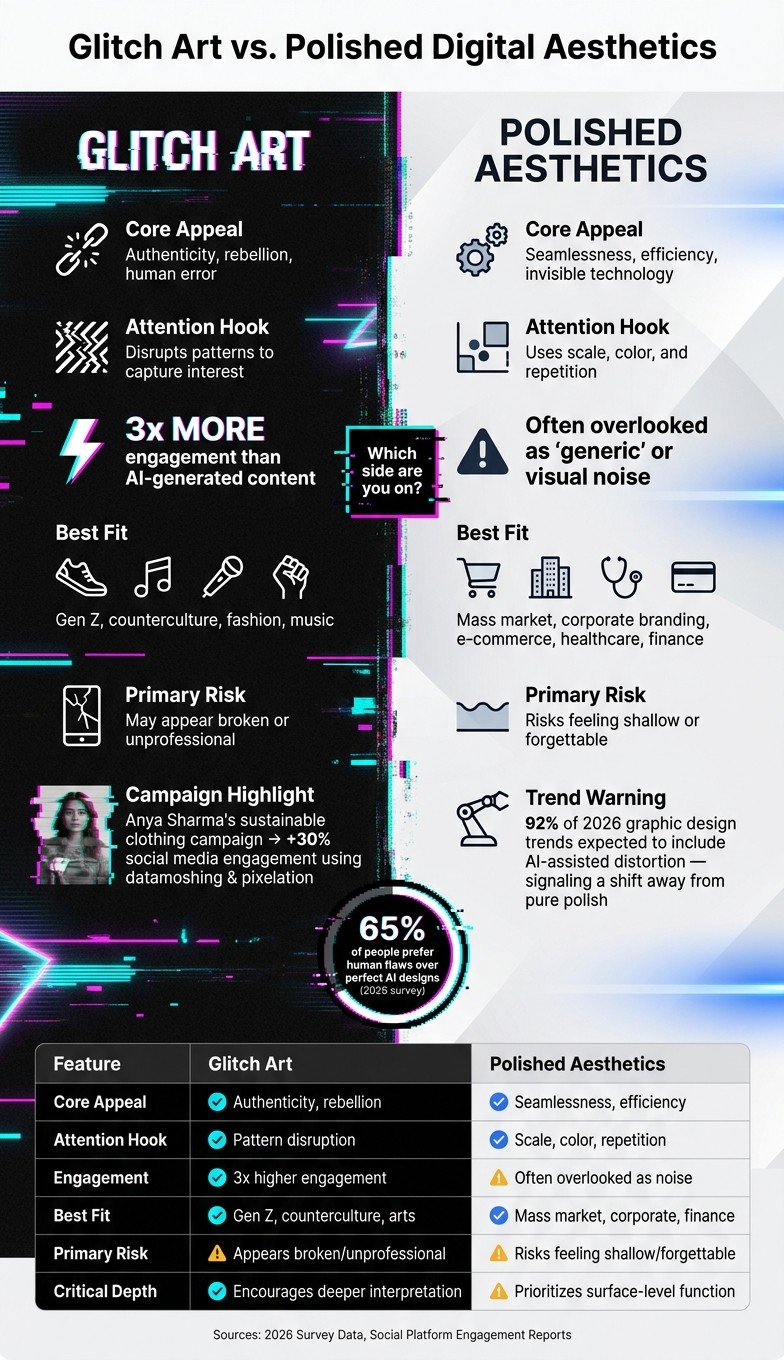
Glitch Art vs. Polished Digital Aesthetics: Key Differences & Stats
Both glitch art and polished aesthetics bring their own set of strengths and challenges to the table. Deciding between the two often comes down to your message, audience, and the emotions you aim to evoke.
The numbers back this up: surreal, glitch-heavy visuals generate 3x more engagement than photorealistic AI content on major platforms. It’s a clear reminder that context and intent often matter more than striving for flawless perfection.
Take, for example, a sustainable clothing campaign led by digital artist Anya Sharma in April 2025. Instead of traditional, polished modeling shots, Sharma used datamoshing, static, and pixelation to align with the brand's message of waste reduction. The result? A 30% increase in social media engagement. Sharma explained the success of this approach:
"People are hungry for honesty, even if that honesty is a bit…broken." - Anya Sharma, Digital Artist
However, glitch art isn’t without risks. When used improperly or without clear intention, it can come across as an actual technical error rather than a creative choice. In industries like healthcare or finance, where trust and reliability are critical, such visual distortions could harm credibility.
Here’s a side-by-side comparison of the two approaches to help illustrate their strengths and challenges:
Feature | Glitch Art | Polished Digital Aesthetics |
|---|---|---|
Core Appeal | Emphasizes authenticity, rebellion, and human error | Highlights seamlessness, efficiency, and invisible technology |
Attention Hook | Captures interest by disrupting patterns | Leverages scale, color, or repetition to stand out |
Engagement | Surreal/glitch styles drive 3x higher engagement | Predictable but often overlooked as "generic" |
Best Fit | Appeals to Gen Z, counterculture, fashion, and music | Suits mass market, corporate branding, and e-commerce |
Primary Risk | May be perceived as broken or unprofessional | Risks feeling shallow or forgettable |
Critical Depth | Highlights the presence of machines; can act as a diagnostic tool | Masks labor, costs, and surveillance |
Polished aesthetics focus on clarity and efficiency, often blending seamlessly into the background. In contrast, glitch art thrives on emotional impact, forcing viewers to pause and take notice by breaking familiar patterns. This tension between subtlety and boldness shapes not only artistic choices but also how brands and creators define their visual identities in a crowded digital landscape.
Conclusion
Polished design often masks the machinery behind it. Glitch art, on the other hand, puts that machinery in full view - and it’s this raw honesty that resonates with modern audiences. The findings in this analysis reveal a clear trend: people are leaning toward authenticity rather than algorithmic precision. This evolution calls for a fresh perspective on artistic strategy. For creators, it’s not about discarding skill but knowing exactly where to disrupt it. Designer Eleni Ioannidou captures this sentiment perfectly:
"I like keeping small imperfections because they remind you that a person was involved in the process."
This approach shapes creative decisions. Whether you’re a motion designer playing with displacement maps or a brand aiming to stand out in a crowded feed, embracing intentional imperfections can be your strongest tool. As Francesco D’Isa aptly said, "Aesthetic value, in an age of pervasive optimization, might coincide with distance from the predictable."
For those committed to building a standout visual identity, Future Gold Media operates with this philosophy at its core. Based in Indianapolis, the agency highlights groundbreaking artists worldwide who reject conformity and helps athletes, creators, and organizations establish lasting visual legacies fueled by raw, untamed creativity - not cookie-cutter designs.
Forget perfection - break a layer, and let the digital scars tell your story.


Let’s keep in touch.
Discover more about high-performance web design. Follow us on Twitter and Instagram.